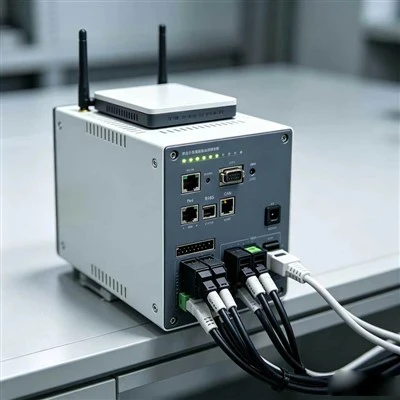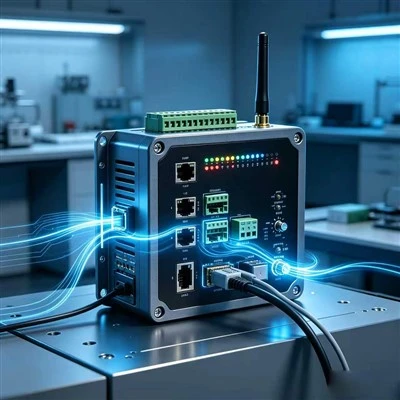

1. Real-time Performance and Low Latency
One of the primary advantages of AI edge controllers is their ability to deliver millisecond-level, real-time responses. Because data is processed locally rather than being uploaded to the cloud, network latency issues are avoided. For instance, on an industrial production line, an AI edge controller can monitor product quality in real time; if a defect is detected, it immediately triggers a sorting mechanism, thereby ensuring both production efficiency and product quality.
2. High Reliability and Security
Traditional cloud-based AI models rely on network connectivity; if the network fails, the system may cease to function properly. In contrast, AI edge controllers operate locally and can function independently even without a network connection, ensuring the continuity of industrial production. Furthermore, since sensitive data does not need to be uploaded to the cloud, the risk of data leakage is reduced, making these controllers ideal for scenarios requiring high levels of data security.
3. Flexibility and Scalability
AI edge controllers typically feature a modular design and support various communication protocols (such as Modbus, OPC UA, and EtherCAT), allowing for easy integration with diverse industrial equipment and sensors. Additionally, their AI algorithms can be updated remotely via OTA (Over-the-Air) technology to adapt to evolving industrial requirements.
4. Energy Efficiency and Cost Optimization
Edge computing reduces the volume of data transmission, thereby lowering costs associated with network bandwidth and cloud services. AI edge controllers can also optimize equipment operation through intelligent algorithms; for example, predictive maintenance capabilities allow for the early detection of equipment faults, reducing downtime and maintenance costs.
5. Support for Diverse AI Application Scenarios
AI edge controllers are capable of running a wide range of AI models, including those for computer vision, speech recognition, and anomaly detection. For example, in smart warehousing, AI edge controllers can utilize visual recognition technology to automate cargo sorting; in energy management, they can analyze power consumption data to optimize energy distribution.