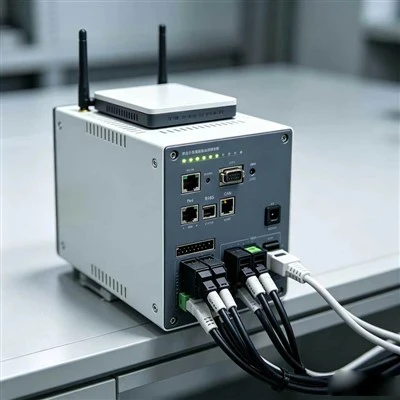

The term "switch" (in the context of networking) originated from the English word "switch," which originally meant a simple on/off mechanism; when introduced to the Chinese technical community, it was translated as "exchange" or "switching" (*jiaohuan*). In English, the verb "to switch" and the noun "switch" share the same word (note that "switching" here specifically refers to signal switching in telecommunications technology, distinct from the exchange of physical goods).
Local Area Network (LAN) switching equipment emerged in 1993, and by 1994, a wave of enthusiasm for switched network technology had swept through China. Essentially, switching technology delivers products characterized by simplicity, low cost, high performance, and high port density; it embodies complex switching capabilities-derived from bridging technology-that operate at Layer 2 of the OSI reference model. Like bridges, switches make relatively simple forwarding decisions based on the MAC address contained in each packet, generally without considering deeper information hidden within the packet. Unlike bridges, however, switches offer minimal forwarding latency, delivering performance comparable to a single LAN and far exceeding the forwarding capabilities of standard bridged internetworks.
Switching technology enables bandwidth adjustment across both shared and dedicated LAN segments, thereby alleviating bottlenecks in inter-LAN traffic. Switching products are available for Ethernet, Fast Ethernet, FDDI, and ATM technologies.
Much like traditional bridges, switches provide a range of network interconnection functions. They can cost-effectively segment a network into smaller collision domains, providing higher bandwidth to individual workstations. Protocol transparency allows switches to be installed directly into multi-protocol networks with minimal software configuration; they utilize existing cabling, repeaters, hubs, and workstation network interface cards (NICs), eliminating the need for high-level hardware upgrades. Furthermore, switches are transparent to workstations, resulting in low management overhead and simplifying tasks such as adding, moving, or reconfiguring network nodes.
The use of specially designed integrated circuits enables switches to forward data in parallel across all ports at wire speed, offering vastly superior performance compared to traditional bridges. Application-Specific Integrated Circuit (ASIC) technology allows switches to achieve this level of performance even with a high number of ports, while keeping the cost per port lower than that of traditional bridges.